
APR vs Interest Rate: What's the Difference?
When comparing loans or credit cards, you'll see both interest rate and APR. Here is exactly how they differ and why APR is the key to comparing borrowing costs.
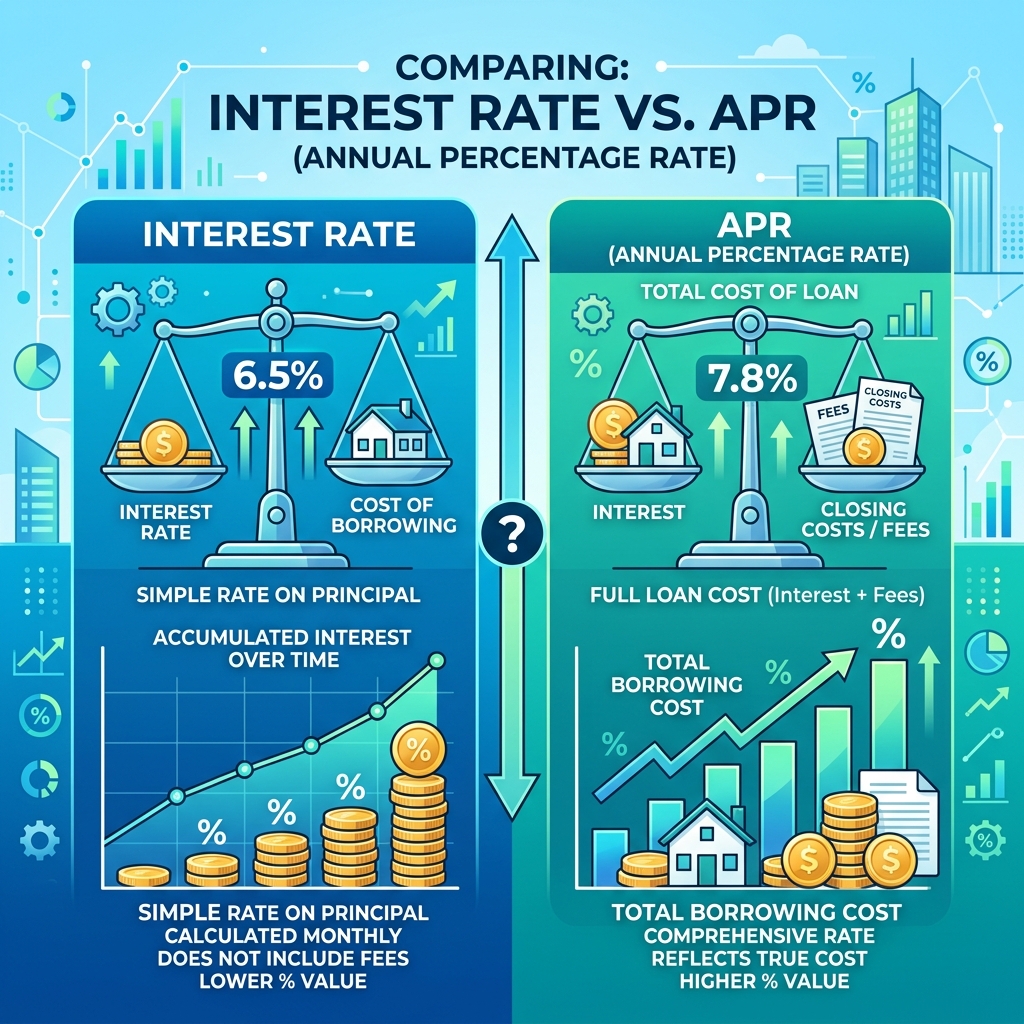
When you're comparing loans, mortgages, or credit cards, you'll usually see two numbers side by side: the interest rate and the APR (Annual Percentage Rate). They look similar, they're both expressed as percentages, and lenders often display them right next to each other — which is exactly why so many borrowers confuse the two.
Here's the short answer: your interest rate is the cost of borrowing the principal amount, while your APR includes the interest rate plus most of the additional fees and costs of the loan, expressed as a yearly rate. APR is almost always the more accurate number to use when comparing offers from different lenders.
This guide breaks down exactly what each figure means, how they're calculated, and which one you should actually rely on when shopping for a loan in the UK or USA. You can also use CalQora's APR calculator to work out your own numbers in seconds.
What Is an Interest Rate?
The interest rate is the percentage a lender charges you for borrowing money, calculated only on the principal balance. It's the "sticker price" of the loan and directly determines your monthly payment amount.
For example, if you borrow $10,000 at a 6% interest rate, the lender is charging you 6% per year on the outstanding balance — nothing more. Interest rates can be:
- Fixed: stays the same for the life of the loan.
- Variable: moves up or down with a benchmark rate (like the Bank of England base rate in the UK or the Federal Reserve rate in the USA).
Interest rate alone tells you how much you'll pay in pure interest, but it doesn't reflect the full cost of taking out the loan.
What Is APR?
APR (Annual Percentage Rate) represents the total yearly cost of borrowing, including the interest rate plus most mandatory fees, such as:
- Origination fees
- Broker fees
- Mortgage insurance (in some cases)
- Closing costs (for certain loan types)
- Discount points
Because APR bundles in these extra costs and spreads them across the loan term, it gives a more complete picture of what you'll actually pay annually to borrow the money. This is why APR is the number regulators require lenders to disclose prominently — it's designed specifically to make loan comparison easier and more transparent.
Interest Rate vs APR: Key Differences
| Factor | Interest Rate | APR |
|---|---|---|
| What it measures | Cost of borrowing the principal only | Total yearly cost including fees |
| Used to calculate | Your monthly payment | Full cost of the loan over time |
| Includes fees? | No | Yes (most mandatory fees) |
| Better for comparing lenders? | Less accurate | More accurate |
| Typically higher or lower? | Usually lower | Usually equal or higher |
In almost every case, APR will be equal to or higher than the interest rate, because it includes additional costs. If a lender quotes an APR that's identical to the interest rate, it usually means there are little to no additional fees attached to the loan.
Why the Difference Matters When Comparing Loans
Two lenders can advertise the exact same interest rate but have very different APRs once fees are factored in. For example:
- Lender A: 5.5% interest rate, $0 fees → APR of 5.5%
- Lender B: 5.5% interest rate, $3,000 in fees → APR of 5.9%
If you only compared interest rates, both loans would look identical. But Lender B is actually more expensive once you account for the fees — and APR is what reveals that. This is especially important for mortgages (where fees run into thousands of pounds or dollars) and personal loans.
APR and Interest Rate in Mortgages
Mortgage APR vs interest rate is one of the most common places borrowers get confused, because mortgage APR calculations spread one-time closing costs across the entire loan term.
- The interest rate determines your actual monthly mortgage payment.
- The APR reflects the cost of the loan if you keep it for the full term, including points, broker fees, and certain closing costs.
If you plan to pay off or refinance your mortgage early, APR can actually be misleading, since it assumes you'll keep the loan for its entire duration and spreads the fees accordingly. In that case, comparing the interest rate and the upfront fees separately may give you a clearer picture.
How APR Differs Between the UK and USA
While the core concept is the same, there are some regional differences worth knowing:
In the UK, lenders are required to display a Representative APR, which must be offered to at least 51% of successful applicants. This is regulated under rules enforced by the Financial Conduct Authority (FCA).
In the USA, APR disclosure is required under the Truth in Lending Act (TILA), enforced with guidance from the Consumer Financial Protection Bureau (CFPB). US lenders must show APR on all consumer credit agreements.
How to Calculate the Difference Yourself
To quickly see how a loan's fees affect its true annual cost:
- Enter the loan amount, interest rate, and loan term into a calculator.
- Add any known fees (origination, broker, or closing costs).
- Run it through CalQora's APR calculator to instantly see your effective APR alongside the base interest rate.
- Compare that APR against other loan offers to see which is genuinely cheaper over time.
Common Mistakes Borrowers Make
- Comparing interest rates only: Two loans with the same rate can have very different total costs once fees are included.
- Assuming APR always applies evenly: Mortgage APR assumes you keep the loan for its full term — paying it off early changes the real cost.
- Ignoring variable-rate APR changes: If your interest rate is variable, your APR is only an estimate based on current rates and can change over the life of the loan.
This article is for general information and educational purposes only. Financial terms and interest rates vary. Always consult a certified financial advisor or mortgage broker before signing any lending agreement.