
Percentage Calculator: Complete Beginner Guide
Percentages are used everywhere, from retail discounts to interest rates. Here is how to work them out step by step in everyday life.
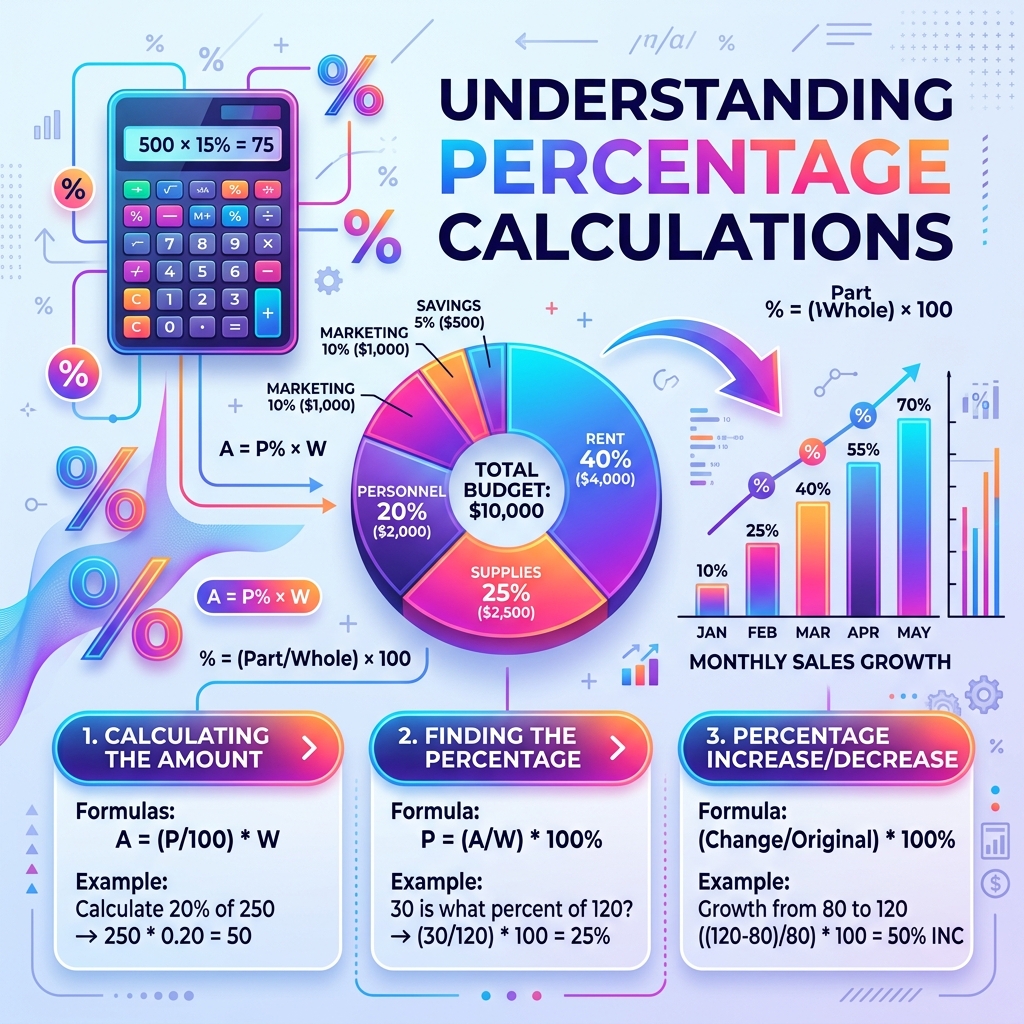
Percentages show up everywhere — discounts at checkout, exam grades, tax rates, tips at restaurants, interest on savings, and salary raises. Yet a surprising number of people still hesitate when asked to work one out by hand. The good news is that percentages follow a small handful of simple formulas, and once you understand them, you can calculate almost anything involving percentages in seconds.
The core idea: a percentage is simply a fraction out of 100. "25%" literally means 25 out of every 100. Once that clicks, every percentage calculation — whether it's finding a discount, a percentage increase, or a percentage change — becomes a variation on the same basic idea.
This guide walks through every common percentage calculation step by step, with real examples you'll actually encounter. You can also skip the manual math entirely using CalQora's free percentage calculator.
What Is a Percentage?
The word "percent" comes from the Latin per centum, meaning "per hundred." So:
- 50% = 50 out of 100 = half
- 25% = 25 out of 100 = a quarter
- 10% = 10 out of 100 = a tenth
Mathematically, a percentage is just a fraction with a denominator of 100, which is why converting between percentages, fractions, and decimals is straightforward:
- Percentage → decimal: divide by 100 (e.g., 25% = 0.25)
- Decimal → percentage: multiply by 100 (e.g., 0.6 = 60%)
- Fraction → percentage: divide the numerator by the denominator, then multiply by 100 (e.g., 3/4 = 0.75 = 75%)
How to Calculate a Percentage of a Number
This is the most common percentage calculation: finding what a certain percentage of a number equals.Formula: Percentage of a number = (Percentage ÷ 100) × Number
Example: What is 20% of 150?(20 ÷ 100) × 150 = 0.20 × 150 = 30
This is the exact calculation behind working out a restaurant tip, a sale discount, or a commission on a sale.
How to Find What Percentage One Number Is of Another
Sometimes you need to flip the question: instead of finding a percentage of a number, you want to know what percentage one number represents of another.Formula: Percentage = (Part ÷ Whole) × 100
Example: You scored 42 out of 60 on a test. What percentage is that?(42 ÷ 60) × 100 = 0.70 × 100 = 70%
How to Calculate Percentage Increase
Percentage increase tells you how much something has grown relative to its original value — useful for salary raises, price hikes, or population growth.Formula: Percentage Increase = ((New Value − Original Value) ÷ Original Value) × 100
Example: Your salary went from £30,000 to £33,000. What's the percentage increase?((33,000 − 30,000) ÷ 30,000) × 100 = (3,000 ÷ 30,000) × 100 = 10%
How to Calculate Percentage Decrease
Percentage decrease works the same way but measures a reduction — useful for discounts, weight loss tracking, or falling prices.Formula: Percentage Decrease = ((Original Value − New Value) ÷ Original Value) × 100
Example: A $80 jacket is now $60. What's the percentage decrease?((80 − 60) ÷ 80) × 100 = (20 ÷ 80) × 100 = 25%
How to Calculate Percentage Change
"Percentage change" is a general term that covers both increase and decrease, using the same underlying formula but allowing for a negative result when the value drops.Formula: Percentage Change = ((New Value − Original Value) ÷ Original Value) × 100
A positive result means an increase; a negative result means a decrease. This is the version most commonly used in finance and statistics.
How to Reverse a Percentage (Finding the Original Number)
This is where most people get stuck: if you know the result after a percentage has been applied, how do you find the original number?
Original Number = Final Value ÷ (1 + Percentage as a decimal)— for an increaseOriginal Number = Final Value ÷ (1 − Percentage as a decimal)— for a decrease
Example: A jacket costs $60 after a 25% discount. What was the original price?60 ÷ (1 − 0.25) = 60 ÷ 0.75 = $80
Real-Life Examples of Percentage Calculations
- Sales tax (USA): If an item costs $45 and sales tax is 8%, the tax amount is
(8 ÷ 100) × 45 = $3.60, making the total $48.60. - VAT (UK): If an item costs £100 excluding VAT and VAT is 20%, the VAT amount is
(20 ÷ 100) × 100 = £20, making the total £120. - Restaurant tip: For a $50 bill with an 18% tip, the tip amount is
(18 ÷ 100) × 50 = $9. - Exam grade: Scoring 34 out of 40 equals
(34 ÷ 40) × 100 = 85%.
Percentage Points vs Percentages: A Common Point of Confusion
One subtle but important distinction: if an interest rate moves from 5% to 7%, that's an increase of 2 percentage points, but a percentage increase of 40% ((7−5)÷5 × 100). News reports often use "percent" and "percentage points" interchangeably, which can lead to confusing or misleading headlines.
Step-by-Step: Using CalQora's Percentage Calculator
Rather than working through formulas by hand every time, you can get instant results using CalQora's tools:
- Go to CalQora's Percentage Calculator.
- Choose the type of calculation you need: percentage of a number, percentage change, or reverse percentage.
- Enter your two known values (e.g., original price and new price).
- Get an instant, accurate result without manual formula work.
Common Mistakes People Make
- Confusing percentage points with percentage change: A move from 10% to 12% is 2 percentage points, but a 20% relative increase.
- Applying the wrong base number: Percentage increase and decrease always use the original value as the denominator, not the new value.
- Forgetting to convert percentages to decimals before multiplying: 20% must become 0.20 in the formula, not 20.
- Mixing up "percentage of" with "percentage change": "20% of 150" and "a 20% increase on 150" give different results (30 vs 180).
This article is for general information and educational purposes only. Always cross-verify calculated values before using them in official financial reports, transaction agreements, or tax filings.